MeteoPomarico is the weather portal I manage for Pomarico and the Ionian Coast area. It has been online since 2011, originally born as a personal project to monitor the weather in my hometown, and over the years it has grown into a complete platform used by many people in the local area.
The idea behind it is simple: provide truly local weather data, measured on site, instead of relying only on generic forecasts or broad regional averages. For this reason, the project is built around a professional WeatherFlow Tempest weather station physically installed in Pomarico, continuously collecting temperature, humidity, pressure, wind, rain, UV index, solar radiation and lightning activity — all values measured by its own sensors, not derived from external models.
The data is collected, stored, processed and published in real time on the website. Around the station, I gradually built a wider system that integrates forecasts, historical data, weather alerts, EUMETSAT satellite imagery, marine conditions and social media automation.
The website was redesigned in October 2026.
What it offers
MeteoPomarico lets users check current weather conditions through a frequently updated dashboard designed to be readable both on desktop and mobile. Beyond live data, the website shows recent trends and makes it possible to analyse temperature, humidity and pressure across different time ranges.
Main features include:
- Real-time weather data from the local station
- Historical charts over 24 hours, 7 days and 30 days
- All-time station records: temperature, humidity, pressure, wind and UV
- Daily and hourly forecasts
- Air quality, sunrise, sunset and moon phase
- Civil Protection weather alerts with automatic updates
- EUMETSAT satellite imagery processed into a 24-hour animation
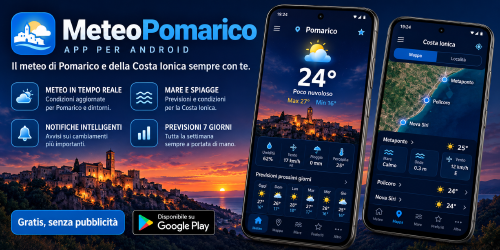
- Marine section for the Ionian Coast with wind, waves, sea temperature and sea state
- Dedicated APIs for the website, app and external integrations
Ionian Coast
From May to October, MeteoPomarico also becomes a practical tool for people who live by the sea or need to decide where to go to the beach. The section dedicated to the Ionian Coast compares conditions across several locations, from Chiatona to Rocca Imperiale, using wind, waves, sea temperature and sea state.
The website processes these data points to provide an immediate reading of the day: which beaches have the best conditions, where the sea is calmer, what kind of wind to expect and whether there are any alerts to consider.
This is one of the parts of the project I care about most, because it takes weather data beyond technical observation and turns it into something useful for everyday life in the local area.
Satellite, storms and lightning
Beyond station data, MeteoPomarico runs a dedicated EUMETSAT satellite imagery pipeline, written in Python on top of Pytroll and Satpy, and shared with LecceMeteo . SEVIRI imagery from EUMETSAT’s Meteosat Second Generation programme is pulled hourly, processed and turned into a 24-hour FFmpeg animation that lets users watch cloud masses and storm systems evolving over the Mediterranean.
From the new Meteosat Third Generation satellites, lightning is already arriving today: MTG’s Lightning Imager sees strikes from space in real time and feeds the lightning counter on the home page. Where ground-based antenna networks used to provide uneven coverage, now every strike is an event observed from the satellite, with position, time and intensity. In the evening, if the day has crossed the lightning threshold, the system composes a vertical reel of the event from MTG’s FCI imagery and publishes it on Instagram and Facebook.
The full description of the satellite pipeline — SEVIRI, Lightning Imager, FCI and the technical constraints of downloading MTG data — lives on the twin project LecceMeteo , which MeteoPomarico shares machines and code with.
Architecture and automation
From a technical point of view, MeteoPomarico is not just a page displaying weather values. It is a PHP platform with a database, JSON APIs, caching, rate limiting, cron jobs and automated monitoring processes, split between a web hosting service, which exposes the site and the APIs, and a few dedicated Debian machines, shared with LecceMeteo, which run the acquisition cron jobs, the satellite pipeline and the social media automation. The How it works page explains how to read the sea label and where the data comes from; the Data use page sets the conditions for reusing it.
The system collects data from multiple sources, normalises it and exposes it through dedicated endpoints. The local station provides observed weather data, while external services complete the picture with forecasts, air quality, marine data and official alerts (the latter published in Italian and English).
An important part of the project is editorial automation. Starting from live weather data, the system generates visual content for Instagram and Facebook: posts, stories and reels are automatically rendered with ImageMagick, turned into video with FFmpeg when needed, and published through the Meta Graph API.
This pipeline handles publishing schedules, deduplication, temporary files, logs, heartbeats and Telegram notifications in case of errors. The goal is to keep the social channels updated without turning every weather change into a manual task.
Why I built it
MeteoPomarico comes from my passion for meteorology, but also from the idea that a technology project has value when it answers a real need. Knowing what the weather is actually doing in a specific place, having a reliable historical archive, receiving an alert in time and accessing local data without unnecessary noise are simple things, but they matter.
Over the years, the project has grown together with my skills: from data collection to visualisation, from APIs to social automation, up to the integration of satellite imagery, marine conditions and notifications. Today, MeteoPomarico is one of the personal projects that best represents the way I work: practical technology, attention to the local territory and automation where it truly helps.
Links
- Website: meteopomarico.it
- Facebook: MeteoPomarico
- Instagram: @meteopomarico


Use the share button below if you liked it.
Your click is my virtual high-five.